Map App Engineer Spanning Tree Escape Room: Cheapest Network
by Creouts Publishing © 2026
Price: $3 USD
Subjects: math,mathHighSchool,mathMiddleSchool,computerscience,computationalThinking,stem,technicalLearning
Grades: 8,9,10,11,12
Description
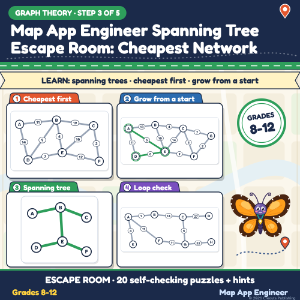
Students learn and practice: trees and the n − 1 rule, spanning trees, cheapest-first (Kruskal) and grow-from-a-start (Prim) networks, loop and crossing checks (Grade 8-12 level). STEP 3 of Map App Engineer (5 escape rooms, bundle 20% off). Story: Waybloom puts a map kiosk in every hill village. Cable is paid by the mile, so the new map engineer plans the cheapest network. HOW IT WORKS: 4 rooms: trees; cheapest first; grow from the start; loop and crossing checks. SELF-CHECKING WITH HINTS 9 typed, 4 tile and 6 tap answers plus the lock. A learn card opens each room; 2 hints per puzzle. Accessible: screen-reader text on every card; keyboard friendly; colors are also named in words. ACCURACY Software re-solves every answer from the drawn cards; AI test sessions solved it from the cards alone. Not tested with a class. SOURCES: OpenStax Contemporary Mathematics (2023), chapter 12; the published work of Euler (1735), Dijkstra (1959), Kruskal (1956), Prim (1957), Appel and Haken (1976). Facts only, no copied text. No endorsement implied. STANDARDS Supports the Standards for Mathematical Practice (MP1, MP4, MP7) and vertex-edge graph topics in NCTM Principles and Standards and in state discrete-math courses. Not tied to a specific Common Core content standard. Maps, streets and travel times are made up for practice. HOW IT WAS MADE Text written with AI help and checked. Pictures drawn in code. Needs internet. For learning only. All characters and places are made up.
Acknowledgements
Text fonts: Atkinson Hyperlegible, (c) Braille Institute of America, SIL Open Font License 1.1; Fredoka, (c) The Fredoka Project Authors, SIL Open Font License 1.1.