Read the Code Escape Room 4: Lists and Indexes From Zero
by Creouts Publishing © 2026
Price: $3 USD
Subjects: computerscience,computationalThinking,edtech
Grades: 7,8,9
Description
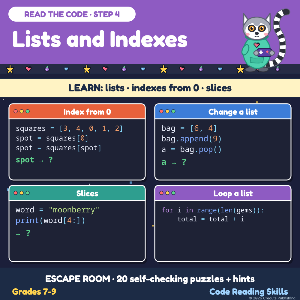
Students learn and practice: list indexes from 0, [-1] and len(), an index past the end, replace, append and pop, slices of lists and text, and loops over a list (total, count, best, position) (Grade 7-9 level). STEP 4 of Learn to Read Code (7 escape rooms, bundle 20% off). Short Python 3 programs on the cards: no install, any device. Story: game jam at the Copperleaf Makerspace. Zinnia the lemur and the team read their AI helper's list code to open the level map folder. 4 rooms, 30 cards. HOW IT WORKS - Room 1: indexes from 0, [-1], len() and the index past the end. - Room 2: replace, append and pop; what pop() hands back. - Room 3: slices [a:b], [:b], [a:] of lists and text. - Room 4: loops over a list: totals, counts, the best item, a match. SELF-CHECKING WITH HINTS 9 typed, 7 tile and 3 tap answers plus the lock. A learn card opens each room; two hints per puzzle. ACCURACY Every program on the cards was run by software, and each answer comes from its real output. Solved from the cards alone by separate AI test sessions. Not tested with a class. SOURCES Aligned with CSTA K-12 CS Standards (2017) 2-AP-11, 2-AP-12, 3A-AP-14; Lister et al. (2004) on code reading and tracing; Sentance, Waite and Kallia (2019), PRIMM (predict before you run); Python 3 documentation. No endorsement implied. HOW IT WAS MADE Text written with AI help and checked. Pictures drawn in code. Needs internet. For learning only. All people and places are made up.
Acknowledgements
Text fonts: Atkinson Hyperlegible, (c) Braille Institute of America, SIL Open Font License 1.1; Fredoka, (c) The Fredoka Project Authors, SIL Open Font License 1.1.