Prioritizing Tasks Escape Room: What to Do First and Why
by Creouts Publishing © 2026
Price: $3 USD
Subjects: sel,selfManagement,responsibleDecisionMaking,lifeSkills
Grades: 4,5,6
Description
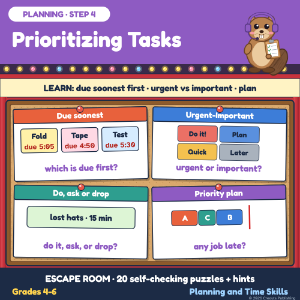
Students learn and practise: putting jobs in "due soonest first" order, working out end times and minutes late for one worker, sorting jobs on an Urgent-Important grid, deciding what to do, plan, hand to a helper or drop, and building a plan where no job is late (Grade 4-6 level). STEP 4 of Plan Tasks, Manage Time, Get Things Done (6 escape rooms, bundle 20% off). Story: Thursday of show week at Cedarwick School, and the stage crew has too many jobs. Bix the beaver helps them choose what to do first to open a locked prop trunk. 4 rooms, 30 cards. HOW IT WORKS - Room 1: due times, end times, minutes late on a plan timeline. - Room 2: urgent (due today) or important (the show needs it)? The grid. - Room 3: do it, plan a time, ask a helper or drop; a to-do list. - Room 4: plans with no late job; why shortest-job-first can fail. SELF-CHECKING WITH HINTS 9 typed, 5 tile and 5 tap answers plus the lock. A learn card opens each room; two hints per puzzle. ACCURACY Software re-reads every job card and plan bar and re-checks every order and plan. Solved from the cards alone by separate AI test sessions. Not tested with a class. SOURCES Jackson (1955), earliest due date rule (UCLA Research Report 43); CASEL self-management ("using planning and organizational skills"). No endorsement implied. HOW IT WAS MADE Text written with AI help and checked. Pictures drawn in code. Needs internet. For learning only. All people and places are made up.
Acknowledgements
Text fonts: Atkinson Hyperlegible, (c) Braille Institute of America, SIL Open Font License 1.1; Fredoka, (c) The Fredoka Project Authors, SIL Open Font License 1.1.