AI Engineer Nearest Neighbors Escape Room: Ask the Closest
by Creouts Publishing © 2026
Price: $3 USD
Subjects: computerscience,computationalThinking,technicalLearning,stem,math,data
Grades: 8,9,10,11
Description
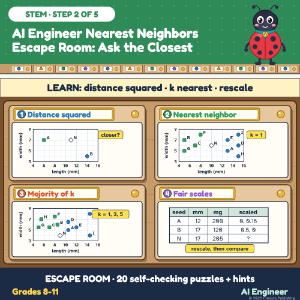
Students learn and practice: distance squared on a grid; k nearest neighbors; min-max rescaling (Grade 8-11 level). STEP 2 of AI Engineer (5 escape rooms, bundle 20% off). Story: the Kernelwick Seed Library builds the Sorter, a seed-sorting machine. At the Neighbor Bench, the junior AI engineer and Flax the ladybug name new seeds by asking the closest labeled ones. HOW IT WORKS - Room 1: distance squared; which seed is closer. - Room 2: k = 1 copies the nearest seed. - Room 3: k = 3, 5: the label most neighbors carry. - Room 4: mm vs mg: rescale, then compare. SELF-CHECKING WITH HINTS 10 typed, 6 tile and 3 tap answers plus the lock. A learn card opens each room; two hints per puzzle. Accessible: screen-reader text on every card; keyboard friendly. ACCURACY Software re-solves every answer from the drawn cards and cross-checks the model math with scikit-learn; AI test sessions solved it from the cards alone. Not tested with a class. SOURCES scikit-learn User Guide (Nearest Neighbors); James, Witten, Hastie, Tibshirani, An Introduction to Statistical Learning, ch. 2 and 4. CSTA 3A-DA-12, 3B-DA-05; AI4K12 Big Idea 3; Common Core 8.G.B.8, 7.RP.A.3. Facts only, no copied text. No endorsement implied. Hand-run machine learning: no coding, no accounts, no AI tool needed. Seed measurements are made up for practice. HOW IT WAS MADE Text written with AI help and checked. Pictures drawn in code. Needs internet. For learning only. All characters and places are made up.
Acknowledgements
Text fonts: Atkinson Hyperlegible, (c) Braille Institute of America, SIL Open Font License 1.1; Fredoka, (c) The Fredoka Project Authors, SIL Open Font License 1.1.