Anchoring Bias: The First Number Effect Escape Room
by Creouts Publishing © 2026
Price: $3 USD
Subjects: math,statisticsAndProbability,responsibleDecisionMaking,cognitionProblemSolving,lifeSkills
Grades: 9,10,11
Description
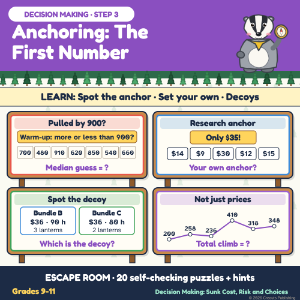
Students learn and practise: how a first number pulls an estimate (anchoring bias), setting your own anchor from past data, spotting decoys and working from the parts (Grade 9-11 level). STEP 3 of Decision Making: Sunk Cost, Risk and Choices (5 escape rooms, bundle 20% off). The story: swap market week at Thistlewood Lake camp. As the crew's Choice Checker, with Bracken the badger, clear 4 rooms; each gives one digit for the Trail Gate. HOW IT WORKS - Room 1 Swap Tent: a jar, high and low warm-up numbers, medians, the pull; build your own estimate. - Room 2 Trading Post: past prices as your anchor, fair offers, split the difference. - Room 3 Lantern Hall: decoys, cost per hour. - Room 4 Picnic Lawn: anchors that are not prices, round numbers, total climb; the lock. - Learn cards: each rule with a worked example. Calculator OK. SELF-CHECKING WITH HINTS - 9 typed answers, 6 tile choices and 5 taps. - Two hints each: a method, then a nudge. ACCURACY Software re-reads the cards and re-checks every answer; every puzzle was solved the same way by 2 separate checkers. Not tested with a class. Errors? Tell us via feedback. SOURCES Tversky, A. and Kahneman, D. (1974), "Judgment under Uncertainty: Heuristics and Biases", Science 185 (general finding only; the deck's numbers are made up). HOW IT WAS MADE Written with AI help. Pictures drawn in code, no AI images. Needs internet. For learning only. All people, places, prices and events in this deck are made up.
Acknowledgements
Text fonts: Atkinson Hyperlegible, (c) Braille Institute of America, SIL Open Font License 1.1; Fredoka, (c) The Fredoka Project Authors, SIL Open Font License 1.1.