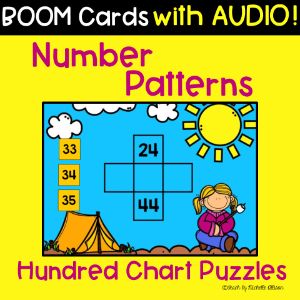
Hundreds Chart | Number Patterns
by Michelle Staley © 2020
Price: $3 USD
Subjects: math
Grades: 1,2,3
Description
Your students will love this deck of number puzzles! Students will extend the counting sequence by working with numbers to 120. Enjoy! Michelle Allison Common Core State Standards Common Core State Standard Correlations: Extend the counting sequence. CCSS.MATH.CONTENT.1.NBT.A.1 Count to 120, starting at any number less than 120. In this range, read and write numerals and represent a number of objects with a written numeral. CCSS.MATH.CONTENT.1.NBT.B.2.C The numbers 10, 20, 30, 40, 50, 60, 70, 80, 90 refer to one, two, three, four, five, six, seven, eight, or nine tens (and 0 ones). CCSS.MATH.CONTENT.1.NBT.B.3 Compare two two-digit numbers based on meanings of the tens and ones digits, recording the results of comparisons with the symbols >, =, and <. Use place value understanding and properties of operations to add and subtract. CCSS.MATH.CONTENT.1.NBT.C.5 Given a two-digit number, mentally find 10 more or 10 less than the number, without having to count; explain the reasoning used. CCSS.MATH.CONTENT.1.NBT.C.6 Subtract multiples of 10 in the range 10-90 from multiples of 10 in the range 10-90 (positive or zero differences), using concrete models or drawings and strategies based on place value, properties of operations, and/or the relationship between addition and subtraction; relate the strategy to a written method and explain the reasoning used.
Acknowledgements
Clipart: Educlips Creating 4 the Classroom Font: KG Fonts